
Why Targeted Cancer Therapies Are Transforming Oncology
Targeted cancer therapies are designed to interfere with specific molecular pathways or cellular receptors that drive tumor growth, survival, and metastasis. Unlike traditional cytotoxic agents, which indiscriminately attack rapidly dividing cells, targeted treatments focus on biomarkers that are overexpressed or uniquely present in cancer cells. This selective mechanism helps maximize therapeutic efficacy while reducing damage to normal tissues.
The success of targeted therapies has fundamentally changed the management of many cancers. Small-molecule inhibitors, monoclonal antibodies, immune checkpoint inhibitors, and antibody-drug conjugates (ADCs) have demonstrated that precision targeting can improve survival rates, delay disease progression, and enhance patients’ quality of life. As researchers continue to identify new tumor-associated receptors and signaling pathways, the range of targetable cancers continues to expand, creating opportunities for increasingly personalized treatment strategies.
Limitations of Conventional Chemotherapy
Despite its proven effectiveness against a wide variety of malignancies, conventional chemotherapy has several well-recognized limitations. Most chemotherapeutic drugs act by disrupting cell division or DNA replication, making them effective against rapidly proliferating cancer cells. However, healthy tissues with high cellular turnover—including the bone marrow, gastrointestinal tract, hair follicles, and reproductive organs—are also affected. As a result, patients often experience severe side effects such as myelosuppression, nausea, mucositis, alopecia, fatigue, and increased susceptibility to infections.
https://hcs-pharma.com/
Another significant challenge is the relatively narrow therapeutic window of many cytotoxic agents. Achieving sufficient drug concentrations within the tumor while avoiding unacceptable systemic toxicity remains difficult. Furthermore, tumors frequently develop resistance through mechanisms such as drug efflux, enhanced DNA repair, mutations in drug targets, or alterations in cellular signaling pathways. Tumor heterogeneity and poor drug penetration into solid tumors further reduce treatment efficacy, highlighting the need for more selective and efficient drug delivery approaches.
Table of Contents
What Are Peptide-Drug Conjugates (PDCs)?
Peptide-drug conjugates (PDCs) are an emerging class of targeted therapeutics designed to improve the precision and effectiveness of cancer treatment. By combining tumor-targeting peptides with potent therapeutic agents, PDCs aim to deliver drugs directly to malignant cells while minimizing exposure to healthy tissues. This targeted approach addresses many of the shortcomings associated with conventional chemotherapy and represents an important step toward more personalized oncology treatments.
Definition
A peptide-drug conjugate is a multifunctional molecular construct consisting of a targeting peptide, a chemical linker, and a biologically active payload. The peptide serves as a molecular guide that selectively binds to receptors overexpressed on cancer cells or within the tumor microenvironment. Once the conjugate reaches its target, the payload is released in a controlled manner to exert its therapeutic effect.
Although most peptide-drug conjugates are being developed for oncology, the same design principles can also be applied to other diseases where selective drug delivery offers clinical benefits, including inflammatory disorders and infectious diseases.
Core Concept of PDCs
The fundamental concept behind peptide-drug conjugates is selective drug delivery. Instead of exposing the entire body to highly potent cytotoxic agents, peptide-drug conjugates exploit molecular differences between cancerous and healthy tissues to concentrate treatment where it is needed most.
Many tumors overexpress specific cell surface receptors that are either absent or present at much lower levels in normal tissues. Targeting peptides are engineered to recognize these receptors with high affinity, enabling the conjugate to accumulate preferentially within the tumor. This receptor-guided approach enhances local drug concentration while reducing systemic toxicity.
Unlike passive drug delivery, which relies primarily on the enhanced permeability and retention (EPR) effect, peptide-drug conjugates use active targeting mechanisms to improve treatment specificity. As a result, they have the potential to increase therapeutic efficacy even in tumors where passive accumulation alone is insufficient.
Comparison with Traditional Chemotherapy
Traditional chemotherapy relies on cytotoxic drugs that circulate throughout the body and attack rapidly dividing cells regardless of whether they are malignant or healthy. While this broad mechanism of action can effectively reduce tumor burden, it also causes significant collateral damage to normal tissues, leading to well-known side effects such as bone marrow suppression, gastrointestinal toxicity, hair loss, and fatigue.
Peptide-drug conjugates take a fundamentally different approach. Instead of distributing cytotoxic agents indiscriminately, they use peptide ligands to direct the drug toward tumor-specific receptors. This selective delivery offers several potential advantages:
- Increased drug concentration within tumor tissue
- Reduced exposure of healthy organs to toxic compounds
- Improved therapeutic index
- Lower incidence of systemic adverse effects
- Potential to overcome certain forms of drug resistance through receptor-mediated uptake
Although peptide-drug conjugates are not a replacement for conventional chemotherapy in every clinical setting, they represent a promising strategy for improving treatment precision while preserving the potency of established anticancer drugs.
Essential Components of Peptide-Drug Conjugates
The therapeutic performance of a peptide-drug conjugates depends on the careful integration of several functional components. Each element plays a distinct role in determining the conjugate’s specificity, stability, pharmacokinetics, and overall clinical efficacy.
Targeting Peptide
The targeting peptide is the recognition element responsible for directing the conjugate toward cancer cells. These peptides are typically short amino acid sequences engineered or selected for their ability to bind receptors that are highly expressed on tumor cells but minimally expressed in normal tissues.
Common receptor targets include:
- Integrins (particularly αvβ3 and αvβ5)
- Somatostatin receptors
- Prostate-specific membrane antigen (PSMA)
- Gastrin-releasing peptide receptor (GRPR)
- CXCR4 chemokine receptor
Because peptides are considerably smaller than monoclonal antibodies, they often exhibit superior tumor penetration and can access regions of solid tumors that larger molecules may struggle to reach.
How Peptide-Drug Conjugates Work
The therapeutic activity of peptide-drug conjugates follows a sequence of carefully coordinated biological events that collectively maximize drug delivery to cancer cells while limiting systemic exposure.
Tumor Recognition
Following systemic administration, the targeting peptide circulates through the bloodstream until it encounters tumor cells expressing its specific receptor. High-affinity interactions between the peptide and receptor allow the conjugate to accumulate preferentially at the tumor site.
Why Peptides Are Attractive Targeting Molecules
Peptides have emerged as highly promising targeting ligands in modern drug delivery systems, particularly in peptide-drug conjugates (PDCs). Their structural versatility, biological compatibility, and ease of engineering make them especially suitable for precision oncology applications. At the same time, peptides also present important pharmacokinetic and stability challenges that must be addressed to fully unlock their therapeutic potential.
Advantages
High Specificity
One of the most important advantages of peptides is their ability to bind selectively to receptors that are overexpressed on cancer cells. Through rational design or phage display selection, peptides can achieve high affinity and specificity toward tumor-associated targets such as integrins, somatostatin receptors, or PSMA. This specificity enables selective drug accumulation in malignant tissues while minimizing off-target effects in healthy organs, thereby improving the therapeutic index.
Low Immunogenicity
Compared with larger biomolecules such as monoclonal antibodies, peptides generally exhibit low immunogenic potential. Their small size and natural amino acid composition reduce the likelihood of triggering strong immune responses. This makes them suitable for repeated administration, which is often required in chronic cancer treatment regimens.
Easy Synthesis
Peptides can be synthesized efficiently using well-established solid-phase peptide synthesis (SPPS) techniques. This method allows precise control over amino acid sequence, enabling rapid generation of diverse peptide libraries. The simplicity of synthesis also facilitates structural modifications aimed at improving receptor binding, stability, or pharmacokinetic behavior.
Cost-Effective Manufacturing
The production of peptides is generally less complex and less expensive than the manufacture of monoclonal antibodies or other large biologics. Reduced production costs can translate into improved scalability and broader accessibility of peptide-based therapeutics, particularly in resource-limited healthcare systems.
Excellent Tissue Penetration
Due to their relatively small molecular size, peptides can penetrate solid tumors more effectively than larger biologics. This property allows them to access poorly vascularized tumor regions that are often difficult for antibodies to reach. Enhanced tissue penetration increases the likelihood of uniform drug distribution within the tumor microenvironment, potentially improving therapeutic outcomes.
Rapid Optimization
Peptides are highly amenable to chemical modification, enabling rapid optimization of their pharmacological properties. Structural changes such as cyclization, incorporation of non-natural amino acids, or sequence truncation can significantly improve stability, receptor affinity, and in vivo performance. This flexibility accelerates the drug development process and supports iterative design strategies.
Challenges
Short Plasma Half-Life
A major limitation of peptides is their rapid clearance from the bloodstream. Their small size often results in fast renal filtration, which reduces circulation time and limits the duration of therapeutic exposure. As a consequence, frequent dosing or chemical modification strategies are often required to maintain effective drug levels.
Proteolytic Degradation
Peptides are susceptible to enzymatic degradation by proteases present in blood and tissues. This instability can significantly reduce bioavailability and compromise therapeutic efficacy. Without structural modifications, many peptides are rapidly broken down before reaching their target sites.
Rapid Renal Clearance
Because of their low molecular weight, peptides are efficiently filtered by the kidneys and excreted in urine. While this property can reduce systemic toxicity, it also limits the amount of drug that reaches the tumor. Strategies such as PEGylation or albumin binding are often explored to extend circulation time.
Stability Concerns
In addition to enzymatic degradation, peptides may also suffer from chemical instability, including oxidation, deamidation, or aggregation under physiological conditions. These factors can affect both shelf-life and in vivo performance, posing challenges for formulation and long-term storage.
Target Receptors Used in PDC Therapy
A central factor determining the success of peptide-drug conjugates (PDCs) is the selection of appropriate molecular targets on cancer cells. These receptors enable selective binding and internalization of the therapeutic conjugate, ensuring that cytotoxic payloads are delivered preferentially to tumor tissue. Many of the most promising targets are surface receptors that are overexpressed in malignant cells compared to normal tissues, making them ideal candidates for precision oncology strategies.
Integrins
Integrins are transmembrane adhesion receptors that play a key role in cell–extracellular matrix interactions, migration, and angiogenesis. Several integrins are overexpressed in tumors and tumor-associated vasculature, making them attractive targets for peptide-drug conjugates design.
αvβ3 Integrin
The αvβ3 integrin is one of the most extensively studied targets in peptide-based drug delivery. It is highly expressed in angiogenic blood vessels and certain tumor cells, but has limited expression in most normal adult tissues. This differential expression makes it particularly useful for tumor-selective targeting.
RGD Peptides
The RGD (Arg-Gly-Asp) motif is a well-characterized peptide sequence that binds strongly to αvβ3 and related integrins. RGD-based peptides are widely used as targeting ligands in peptide-drug conjugates due to their high affinity, stability, and ability to promote receptor-mediated internalization. Their modular structure also allows easy conjugation to a variety of cytotoxic payloads.
Somatostatin Receptors
Somatostatin receptors (SSTRs), particularly SSTR2, are overexpressed in several neuroendocrine tumors. These receptors naturally bind somatostatin, a regulatory peptide involved in hormone secretion and cell proliferation.
In peptide-drug conjugates applications, somatostatin analogs are used as targeting ligands to deliver cytotoxic agents specifically to SSTR-positive tumors. This approach has been especially valuable in imaging and therapy of neuroendocrine malignancies, where receptor density is often high and relatively homogeneous.
Gastrin-Releasing Peptide Receptor (GRPR)
GRPR is a G-protein-coupled receptor that is frequently overexpressed in cancers such as prostate, breast, and small-cell lung cancer. It binds gastrin-releasing peptide, which is involved in cell growth and proliferation.
GRPR-targeting peptides enable selective accumulation of peptide-drug conjugates in tumors expressing this receptor. Because GRPR expression is limited in most normal tissues, it provides a favorable therapeutic window for targeted drug delivery. Ongoing research explores GRPR-directed conjugates for both diagnostic imaging and therapeutic applications.
Prostate-Specific Membrane Antigen (PSMA)
PSMA is a transmembrane glycoprotein highly expressed in prostate cancer cells, particularly in advanced and metastatic disease. It is also present in tumor-associated neovasculature of several other cancers, though at lower levels.
PSMA-targeting peptides have become a major focus in targeted therapy development. In peptide-drug conjugates systems, PSMA binding enables efficient internalization of the conjugate into prostate cancer cells, making it an attractive platform for delivering highly potent cytotoxic agents with improved tumor selectivity.
CXCR4
CXCR4 is a chemokine receptor involved in cell migration, immune cell trafficking, and tumor metastasis. It is overexpressed in many aggressive cancers and is strongly associated with poor prognosis, metastatic spread, and treatment resistance.
Targeting CXCR4 with peptide-based ligands allows peptide-drug conjugates to interfere with tumor progression while simultaneously delivering cytotoxic payloads. Because CXCR4 plays a role in tumor microenvironment interactions, it also represents a promising target for disrupting metastatic signaling pathways in addition to direct tumor cell killing.
Other Emerging Tumor Biomarkers
Beyond well-established targets, a growing number of tumor-associated receptors and biomarkers are being explored for peptide-drug conjugates development. These include:
- Fibroblast activation protein (FAP), expressed in cancer-associated fibroblasts
- Epidermal growth factor receptor (EGFR), overexpressed in multiple epithelial cancers
- CD13 (aminopeptidase N), associated with tumor angiogenesis
- Vascular endothelial growth factor receptors (VEGFRs), involved in tumor vascularization
- Various tumor-specific neoantigens and stress-induced surface proteins
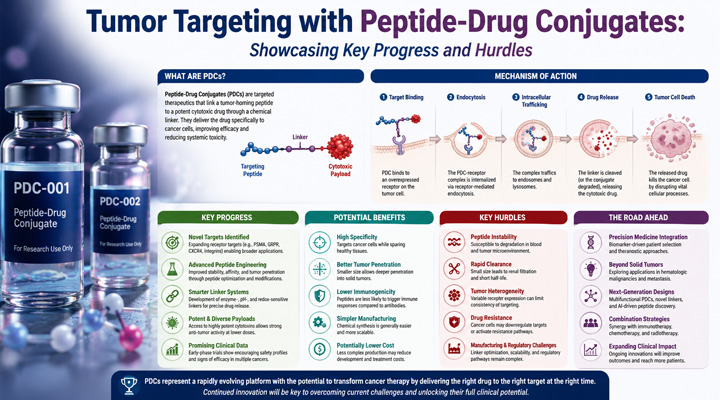
Design Principles of Peptide-Drug Conjugates
The therapeutic effectiveness of peptide-drug conjugates (PDCs) depends on the rational design of three interconnected components: the targeting peptide, the cytotoxic payload, and the chemical linker that bridges them. Each element must be carefully optimized to ensure selective tumor targeting, systemic stability, and efficient intracellular drug release. The overall design represents a balance between pharmacokinetics, tumor biology, and chemical feasibility.
Selecting the Target Peptide
The selection of an appropriate targeting peptide is the foundational step in peptide-drug conjugates design. This peptide determines the specificity of the conjugate by recognizing and binding receptors that are preferentially expressed on tumor cells or within the tumor microenvironment.
Key considerations include:
- Receptor specificity and density: The target receptor should be highly expressed on cancer cells and minimally present in normal tissues to reduce off-target toxicity.
- Binding affinity: High-affinity interactions improve tumor accumulation and retention.
- Internalization capability: Effective peptide-drug conjugates typically require receptor-mediated endocytosis to deliver the payload intracellularly.
- In vivo stability: Peptides must resist enzymatic degradation long enough to reach the tumor site.
Common strategies for peptide selection include rational design, phage display screening, and optimization of known receptor-binding motifs such as RGD sequences for integrins or somatostatin analogs for SSTRs.
Choosing the Cytotoxic Payload
The cytotoxic payload is the active therapeutic component responsible for inducing cancer cell death. Because peptide-drug conjugates provide targeted delivery, they can utilize highly potent compounds that would be too toxic for systemic administration in free form.
The ideal payload typically has:
- High potency at low concentrations
- A well-defined intracellular target
- Chemical groups amenable to conjugation
- Stability during circulation but activity upon release
Auristatins
Auristatins are synthetic analogs of dolastatin 10 and function as microtubule inhibitors. They prevent tubulin polymerization, leading to cell cycle arrest and apoptosis. Their high potency makes them widely used in targeted conjugates.
Maytansinoids
Maytansinoids are another class of microtubule-targeting agents. They bind to tubulin at a different site than auristatins but produce similar cytotoxic effects. Their extreme potency requires precise targeting, making them suitable for conjugated delivery systems.
Doxorubicin
Doxorubicin is an anthracycline antibiotic that intercalates into DNA and inhibits topoisomerase II, leading to DNA damage. In conjugated form, its systemic cardiotoxicity is reduced while maintaining antitumor efficacy.
Camptothecin Derivatives
Camptothecins inhibit topoisomerase I, preventing DNA replication and transcription. Derivatives such as SN-38 are frequently explored in targeted delivery systems due to their strong antitumor activity.
Other Potent Toxins
Additional payloads under investigation include DNA alkylating agents, pyrrolobenzodiazepines (PBDs), and protein synthesis inhibitors. These agents are often too toxic for systemic use but become viable when selectively delivered to tumor cells.
Linker Design
The linker is a critical structural component that connects the peptide to the payload. It determines when, where, and how the cytotoxic drug is released. An ideal linker must remain stable in circulation but efficiently release the payload once inside the tumor or cancer cell.
Linkers are broadly categorized into cleavable and non-cleavable systems.
Cleavable Linkers
Cleavable linkers are designed to break under specific biological conditions, enabling controlled release of the active drug at the target site.
Enzyme-Sensitive Linkers
These linkers are cleaved by tumor-associated enzymes such as proteases (e.g., cathepsins). Because these enzymes are often upregulated in cancer cells or tumor microenvironments, they provide a mechanism for selective activation.
pH-Sensitive Linkers
Tumor tissues and intracellular compartments such as endosomes and lysosomes exhibit acidic environments. pH-sensitive linkers exploit this difference by undergoing hydrolysis in low-pH conditions, triggering drug release specifically within tumor cells.
Redox-Sensitive Linkers
Redox-sensitive systems respond to differences in intracellular reducing conditions, particularly elevated glutathione levels inside cancer cells. These linkers are stable in the bloodstream but cleave once internalized, releasing the payload in the cytoplasm.
Non-Cleavable Linkers
Non-cleavable linkers do not undergo chemical cleavage in response to biological stimuli. Instead, the entire conjugate must be internalized and degraded within lysosomes to release the active drug.
This approach can improve systemic stability and reduce premature drug release, but it may also alter the pharmacological properties of the released metabolite. Careful design is required to ensure that the intracellular breakdown products retain full cytotoxic activity.
Mechanisms of Tumor Targeting
Peptide-drug conjugates (PDCs) rely on a combination of biological and physicochemical processes to achieve selective drug accumulation in tumor tissues. Unlike conventional chemotherapy, which distributes systemically without discrimination, peptide-drug conjugates are engineered to exploit tumor-specific characteristics and receptor biology. The key mechanisms involved include passive targeting, active targeting, receptor-mediated endocytosis, and controlled intracellular drug release.
Passive Targeting
Passive targeting is based on the inherent structural abnormalities of tumor vasculature. Solid tumors often exhibit leaky blood vessels with irregular architecture and impaired lymphatic drainage. This condition allows macromolecules and nanoscale systems to accumulate preferentially within tumor tissue through what is commonly referred to as the enhanced permeability and retention (EPR) effect.
Although peptide-drug conjugates are generally smaller than nanoparticle-based systems, they can still benefit to some extent from passive accumulation, especially when designed with optimized molecular weight or extended circulation properties. However, passive targeting alone is often insufficient to achieve high tumor specificity, which is why it is typically complemented by active targeting strategies.
Active Targeting
Active targeting refers to the specific binding of peptide ligands to molecular receptors that are overexpressed on cancer cells or tumor-associated stromal components. This mechanism significantly enhances selectivity by enabling direct molecular recognition between the peptide-drug conjugates and its intended target.
In active targeting, the peptide component of the conjugate acts as a “navigation system,” guiding the therapeutic payload to cancer cells expressing receptors such as integrins, PSMA, or somatostatin receptors. This receptor-based interaction increases local drug concentration at the tumor site and improves the therapeutic index by reducing off-target exposure.
Active targeting is particularly valuable in heterogeneous tumors where passive accumulation alone cannot ensure uniform drug distribution.
Receptor-Mediated Endocytosis
Once a peptide-drug conjugate binds to its target receptor on the cancer cell surface, many receptor-ligand complexes undergo internalization through receptor-mediated endocytosis. This cellular process is essential for delivering the conjugate into the intracellular environment where the cytotoxic payload can be activated.
The process typically involves several steps:
- Ligand binding: The peptide binds specifically to its receptor on the cell membrane.
- Membrane invagination: The receptor–ligand complex is engulfed into a vesicle formed from the plasma membrane.
- Endosome formation: The vesicle matures into an early endosome containing the internalized peptide-drug conjugates.
- Trafficking: The endosome is transported within the cell, often maturing into late endosomes and lysosomes.
This pathway ensures that the conjugate is efficiently transported from the cell surface into intracellular compartments where drug release mechanisms are activated.
Intracellular Drug Release
The final step in tumor targeting is the controlled release of the cytotoxic payload inside cancer cells. This step is critical for converting targeted delivery into effective cell killing.
Drug release typically occurs within intracellular compartments such as endosomes or lysosomes, where specific environmental conditions trigger linker cleavage or conjugate degradation.
Key mechanisms include:
- Enzymatic cleavage: Lysosomal enzymes such as cathepsins break peptide-based or enzyme-sensitive linkers.
- pH-driven hydrolysis: Acidic conditions in endosomes and lysosomes promote degradation of acid-labile linkers.
- Redox activation: Elevated intracellular reducing agents, particularly glutathione, can cleave disulfide or redox-sensitive bonds.
- Proteolytic degradation (non-cleavable systems): The entire conjugate is broken down into active drug metabolites within lysosomes.
Once released, the cytotoxic payload diffuses into the cytoplasm or nucleus, where it interacts with essential cellular targets such as microtubules, DNA, or topoisomerase enzymes. This leads to disruption of critical cellular processes, ultimately triggering apoptosis or other forms of programmed cell death.
Comparison with Antibody-Drug Conjugates (ADCs)
Peptide-drug conjugates (PDCs) and antibody-drug conjugates (ADCs) are both important classes of targeted cancer therapeutics designed to deliver highly potent cytotoxic agents directly to tumor cells. While they share a similar conceptual framework—combining a targeting ligand, linker, and drug payload—they differ significantly in molecular structure, pharmacokinetics, manufacturing complexity, and clinical performance characteristics.
A side-by-side comparison highlights the key distinctions between these two modalities.
Feature Comparison: PDCs vs ADCs
| Feature | PDCs | ADCs |
|---|---|---|
| Molecular size | Smaller | Larger |
| Tumor penetration | Better | Moderate |
| Manufacturing complexity | Lower | Higher |
| Immunogenicity | Lower | Higher |
| Plasma half-life | Shorter | Longer |
| Production cost | Lower | Higher |
Molecular Size
PDCs are composed of short peptide sequences linked to small-molecule drugs, resulting in relatively low molecular weight constructs. In contrast, ADCs use monoclonal antibodies as targeting units, which are substantially larger proteins. This size difference strongly influences biodistribution, tissue penetration, and pharmacokinetics.
Smaller peptide-drug conjugates can diffuse more efficiently into dense tumor tissue, including poorly vascularized regions that are often difficult for larger antibody-based systems to access.
Tumor Penetration
Due to their compact size, peptide-drug conjugates generally exhibit superior tumor penetration compared to ADCs. They can more readily traverse the tumor microenvironment and reach deeper cell populations. ADCs, while highly specific, often exhibit limited penetration into solid tumors due to steric hindrance and slower diffusion rates.
However, ADCs compensate for this limitation with prolonged circulation time, which increases the probability of tumor exposure over time.
Manufacturing Complexity
The production of peptide-drug conjugates is typically less complex than that of ADCs. Peptides can be synthesized using well-established solid-phase peptide synthesis techniques, which are highly scalable and reproducible.
In contrast, ADC manufacturing involves several technically demanding steps, including monoclonal antibody production, site-specific conjugation, and strict quality control to ensure batch consistency. These processes require advanced biomanufacturing infrastructure.
Immunogenicity
PDCs generally have lower immunogenic potential due to their small size and simpler composition. This reduces the likelihood of immune system recognition and anti-drug antibody formation.
ADCs, being based on full-length antibodies or large protein structures, carry a higher risk of immunogenic responses, although modern engineering has significantly reduced this issue.
Plasma Half-Life
A key pharmacokinetic difference lies in circulation time. PDCs tend to have shorter plasma half-lives because of rapid renal clearance and enzymatic degradation. This can limit tumor exposure time but may also reduce systemic toxicity.
ADCs benefit from the long half-life of antibodies, which can remain in circulation for extended periods, increasing tumor targeting opportunities but also prolonging systemic exposure.
Production Cost
Due to simpler synthesis methods and fewer bioprocessing requirements, peptide-drug conjugates are generally less expensive to produce. ADCs require more complex biologic manufacturing systems, contributing to significantly higher production costs and more challenging scalability.
Current Challenges
Despite significant progress in the development of peptide-drug conjugates (PDCs), several biological, clinical, and manufacturing challenges continue to limit their full therapeutic potential. These obstacles span from intrinsic peptide properties to tumor biology and large-scale production constraints, and they collectively shape the pace of clinical translation.
Biological Limitations
Peptide Instability
One of the fundamental limitations of PDCs is the inherent instability of peptide-based targeting ligands. Peptides are structurally vulnerable in physiological environments and can rapidly lose functional integrity. Factors such as temperature, pH fluctuations, and interaction with plasma proteins can alter peptide conformation, reducing binding affinity to target receptors.
Enzymatic Degradation
Peptides are highly susceptible to proteolytic cleavage by a wide range of enzymes present in blood and tissues. Proteases such as peptidases and endopeptidases can rapidly break down peptide chains, significantly shortening their functional lifespan. This degradation reduces effective tumor targeting and may require chemical modifications such as cyclization, incorporation of non-natural amino acids, or backbone stabilization to improve resistance.
Renal Filtration
Due to their relatively small molecular size, many peptide-drug conjugates are rapidly cleared from circulation via renal filtration. The kidneys efficiently eliminate low-molecular-weight peptides, resulting in short plasma half-life and limited systemic exposure. While this can reduce off-target toxicity, it also restricts tumor accumulation time and may necessitate frequent dosing or structural modifications to extend circulation.
Clinical Challenges
Tumor Heterogeneity
Tumor heterogeneity is a major barrier to consistent therapeutic response. Within a single tumor, different cell populations may exhibit variable receptor expression, metabolic activity, and drug sensitivity. As a result, even highly specific peptide-drug conjugates may only target a subset of malignant cells, allowing untreated populations to survive and repopulate the tumor.
Target Expression Variability
The success of PDCs depends heavily on the presence and density of specific receptors on tumor cells. However, receptor expression can vary widely between patients, tumor types, and even metastatic sites within the same patient. This variability complicates patient selection and reduces the predictability of therapeutic outcomes.
Drug Resistance
Cancer cells can develop resistance to peptide-drug conjugates through multiple mechanisms, including receptor downregulation, altered internalization pathways, increased efflux of cytotoxic agents, and enhanced DNA repair mechanisms. Over time, these adaptive responses can reduce the effectiveness of peptide-drug conjugates-based therapies, similar to what is observed with conventional chemotherapy.
Future Outlook
Peptide-drug conjugates (PDCs) are positioned at an important inflection point in the evolution of targeted cancer therapy. While still an emerging modality compared with antibody-drug conjugates (ADCs) and small-molecule inhibitors, rapid progress in peptide engineering, linker chemistry, and tumor biology is steadily expanding their therapeutic potential. The future of peptide-drug conjugates is likely to be defined by broader clinical applications, deeper integration with precision medicine, and the development of next-generation multifunctional therapeutics.
Expanding Clinical Indications
One of the most promising directions for peptide-drug conjugates development is the expansion of clinical indications beyond their current early oncology focus. As new tumor-specific receptors are identified and validated, the range of treatable cancers is expected to grow significantly.
Future applications may include:
- Additional solid tumors with well-characterized receptor profiles
- Earlier-stage cancers where tumor burden is lower and targeting efficiency is higher
- Combination regimens with chemotherapy, radiotherapy, or immunotherapy
- Refractory or relapsed cancers where conventional therapies have failed
Improved diagnostic tools for receptor profiling will further enable the selection of patients most likely to benefit from PDC-based therapies, enhancing overall clinical success rates.
Precision Medicine Integration
The integration of PDCs into precision medicine frameworks represents a major step toward individualized cancer therapy. Unlike traditional chemotherapy, which is largely administered based on tumor type and stage, peptide-drug conjugates can be matched to molecular features of a patient’s tumor.
Key developments supporting this integration include:
- Biomarker-driven patient selection: Identification of receptor expression patterns (e.g., PSMA, CXCR4, integrins) to guide therapy choice
- Companion diagnostics: Imaging agents or molecular assays that confirm target presence before treatment
- Theranostic platforms: Dual-function systems that enable simultaneous tumor imaging and drug delivery
- Adaptive treatment strategies: Real-time monitoring of receptor expression changes during therapy
This precision-driven approach is expected to improve response rates while minimizing unnecessary exposure to ineffective treatments.
Opportunities Beyond Solid Tumors
Although most PDC research has focused on solid tumors, there is increasing interest in extending this technology to hematologic malignancies and metastatic disease.
Potential opportunities include:
- Hematologic cancers: Targeting surface receptors on leukemias and lymphomas using peptide ligands adapted for circulating tumor cells
- Metastatic disease: Addressing disseminated tumor cells that express migration-associated receptors such as CXCR4
- Tumor microenvironment targeting: Disrupting cancer-associated fibroblasts, angiogenic vessels, and immune-suppressive niches
- Minimal residual disease: Using highly sensitive peptide targeting to eliminate small populations of resistant cancer cells after primary therapy
These applications could significantly broaden the clinical utility of PDCs beyond localized solid tumors.
Next-Generation Targeted Therapeutics
The next generation of PDCs is expected to incorporate advanced engineering strategies that enhance efficacy, safety, and multifunctionality. Several key innovations are already shaping the field:
- Multifunctional conjugates: Combining therapy, imaging, and immune modulation within a single construct
- Improved peptide engineering: Use of cyclic peptides, stapled peptides, and non-natural amino acids to enhance stability and binding affinity
- Smart linkers: Stimuli-responsive systems that respond to multiple tumor-specific triggers simultaneously
- Nanoparticle hybrid systems: Integration of peptides with nanocarriers to extend circulation time and improve tumor accumulation
- AI-driven design: Computational modeling and machine learning to optimize peptide sequences, receptor binding, and pharmacokinetics
Conclusion
Peptide-drug conjugates (PDCs) represent a rapidly evolving and highly promising class of targeted therapeutics within precision oncology. By combining tumor-selective peptide ligands with potent cytotoxic payloads through carefully engineered linkers, PDCs are designed to deliver drugs directly to malignant cells while minimizing exposure to healthy tissues. This targeted approach reflects a broader shift in cancer treatment toward therapies that are guided by molecular characteristics rather than relying solely on non-specific cytotoxicity.
The growing role of PDCs in precision oncology is closely tied to their ability to improve therapeutic selectivity. Compared with conventional chemotherapy, which often affects both cancerous and normal rapidly dividing cells, PDCs offer the potential for more focused drug delivery. This selectivity can translate into improved efficacy, as higher concentrations of drug reach the tumor site, while also reducing systemic toxicity and treatment-related side effects. As a result, PDCs are increasingly viewed as a strategy to enhance the therapeutic index of highly potent anticancer agents.
At the same time, ongoing innovation is driving the field forward. Advances in peptide engineering are improving stability, receptor affinity, and tumor penetration. Progress in linker chemistry is enabling more precise control over when and where drug release occurs, reducing premature activation in circulation. In parallel, the development of increasingly potent and diverse cytotoxic payloads is expanding the range of biological mechanisms that can be targeted within cancer cells. Together, these improvements are addressing many of the current limitations of PDCs and strengthening their translational potential.
Frequently Asked Questions (FAQ) for Peptide-Drug Conjugates in Cancer Therapy
-
What are peptide-drug conjugates (PDCs)?
Peptide-drug conjugates (PDCs) are targeted cancer therapies that combine a tumor-targeting peptide, a chemical linker, and a potent cytotoxic drug. The peptide guides the drug to cancer cells by binding specific receptors that are overexpressed in tumors, enabling more selective drug delivery.
-
How are PDCs different from traditional chemotherapy?
Unlike traditional chemotherapy, which affects both healthy and cancerous rapidly dividing cells, peptide-drug conjugatess are designed to selectively target tumor cells. This targeted approach helps increase drug concentration at the tumor site while reducing systemic toxicity and side effects.
-
What are the main advantages of peptide-drug conjugates ?
Key advantages include improved tumor specificity, better tissue penetration compared to larger biologics, lower immunogenicity, easier synthesis, and potentially lower manufacturing costs. These features make PDCs attractive for precision oncology applications.
-
What challenges do peptide-drug conjugates face?
Major challenges include peptide instability, rapid enzymatic degradation, and fast renal clearance. Clinically, tumor heterogeneity, variable receptor expression, and drug resistance can limit effectiveness. Manufacturing and linker design also remain complex.
-
Which receptors are commonly targeted by peptide-drug conjugates?
After binding to tumor-specific receptors, peptide-drug conjugates are internalized via receptor-mediated endocytosis. Inside the cell, the linker is cleaved or the conjugate is degraded, releasing the cytotoxic payload, which then disrupts vital cellular processes and induces cell death.
-
Are any peptide-drug conjugates currently approved for clinical use?
True systemic PDCs are still mostly in early clinical development. However, peptide-based therapies such as peptide receptor radionuclide therapy (PRRT) have already demonstrated clinical success, supporting the validity of peptide-guided targeting approaches.
-
How do PDCs compare with antibody-drug conjugates (ADCs)?
PDCs are smaller, penetrate tumors more effectively, and are generally easier and cheaper to manufacture. ADCs, however, have longer circulation times and are more clinically established. Each modality has distinct advantages depending on the clinical context.